
Please: Show (share) your artwork
About getting past "stage fright" and learning to trust that the world needs your work

Public speaking is reputedly the #1 fear of most people. Symptoms may vary when you put yourself or your artwork in front of a crowd. Nausea. Sweaty palms. Quavery voice. My go-to: flushed cheeks and knees like noodles. Putting ourselves “out there” in any form—by publishing a book, giving a reading, or opening a gallery show—strikes terror. Why?
“The trouble with imaginative people,” Austin Kleon suggests, “is that we’re good at picturing the worst that could happen to us.” True, true…
But recently something’s changed for me.
It started on a September afternoon at the Polly Hill Arboretum, when strolling across a meadow, I came to an easel. It held a small oil painting of an immense cherry tree in bloom. I spotted the artist’s model at the far side of the field: the tree, its pink cottony blooms faded, only wet green leaves and a few flattened blossoms left. I returned a month later to that spot, to gaze on the painting and stare at the tree, nearly stripped bare of its foliage with only a complex weave of barren brown branches left behind.
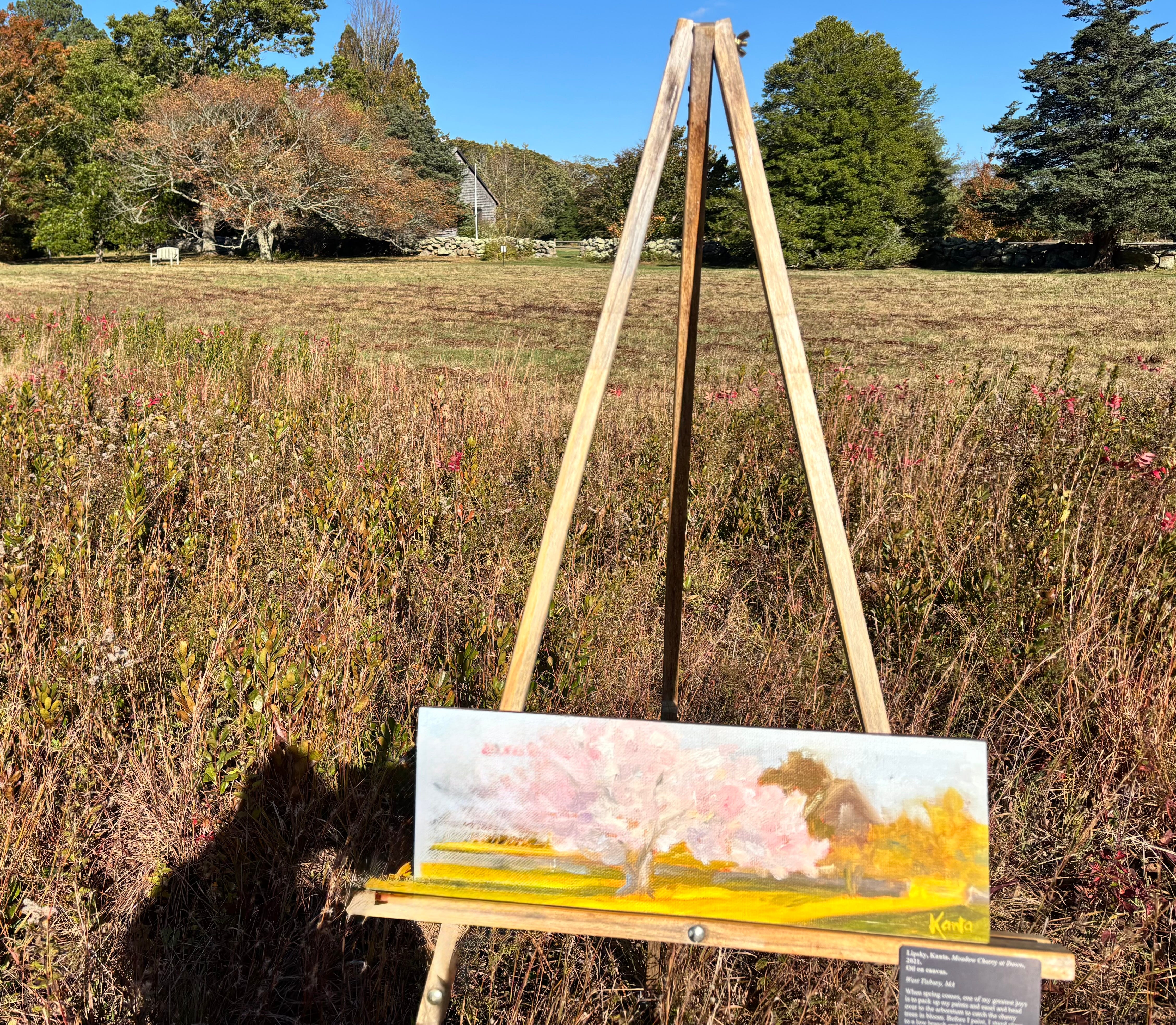
The painting evoked many feelings including awe at how fast those pink blooms burst and fade. Pay attention, I thought. Time sweeps whole worlds away when you’re not watching.
Mostly, I felt gratitude to the artist for sharing her work.
Showing my work never interested me half as much as creating it. It’s always seemed like once I finished something, I was done and off to something else. What was going on?
I instinctively recoil at the thought of speaking, performing, publishing. Showing my work in any way. “Showing” feels too close to “showing off.” Is this a knee-jerk response of a middle child? A defense mechanism? My response to a buried voice: Oh who’s going to care about that?
Seeing the oil painting on an easel in a field sparked a change. That, and opening an exhibit for the first time at the Martha’s Vineyard Museum last month.
It took a friend two years to convince me to get involved with “The Lost History of Innisfail” exhibit. By then, it’d been decades when I first started studying the life and career of the 19th c. romantic tenor Tom Karl and Innisfail, his summertime music colony. I wrote an article about it in 2001; by 2023 I couldn’t imagine many people would care and, if they did, the article was still available. Tom Karl, his once-brilliant career, and his hidden life with his partner of 42 years…they were my private obsession.
That’s why the response, when the exhibit opened, stunned me. People packed the Waggaman Community Gallery opening night and lingered over the displays. People asked questions; a few shared their own findings—photos, old postcards. One couple told me of their conversations with one old-timer still summering in the mid-90s in one of the cottages.


We never know how our work affects others. “Likes” on social media, applause, even book sales don’t tell that story. Because responses aren’t always immediate. A work must find the person who needs to see it. We can’t control that.
This is a golden age of indie publishing and production—by which I mean a book contract with the “Big Five” or being represented by NYC gallerist are no longer required. Hybrid and indie outlets abound; libraries and other community institutions offer gallery space and forums for readings.
Getting your work out is a key step in the creative process, one of the few the creator controls. So, please, show—share—your work. It will matter. Trust that—and try not to worry about the how or the when.
Lovely, Brenda! Really enjoyed this one.
In my decades of work as a designer of 3D spaces, I had to make presentations almost every day. Consequently, I do not fear these things. However, I rarely finish any of my 2D art work. I get bored once I think I've solved the composition problem. It's also probably a secret way to keep everything stacked up in a drawer! Hmmm...
This post is so beautiful and inspiring.